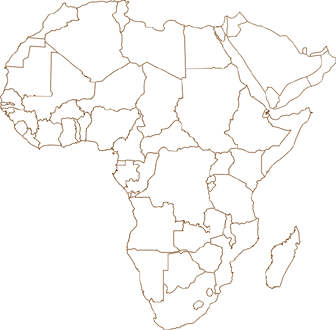
My father sent this to me and I thought it would be nice to share.
Africa needs people to stand and fight for her honour and that is why I pray God can use me and many others to fulfill His will for our beautiful continent!
2007 Archbishop Desmond Tutu Leadership Fellows
February 10, 2008
AN OPEN LETTER TO AFRICA'S PRESENT AND FUTURE LEADERS
“This continent has suffered too much.… We need the assistance and commitment of … young leaders to
continue to speak up on behalf of the poor and the marginalized, and seek a better life for all”
– Archbishop Desmond Tutu, April 2007
From Angola to Zimbabwe, questions abound about Africa’s present state. All capitals listed
between Abidjan to Zanzibar, are not new to the rising voices of Africa’s sons and daughters
who wish to know the fate of their land. Some express this concern through silent hope, others
through evident fear, and many others look in no other direction than that of their leaders –
those we have come to know as the captains of the ship of the state. Others even argue that
Africa’s answers remain with future leaders, and not today’s. But there has been a crisis of
leadership in Africa. The hopes and dreams of the citizens of this continent have been dashed by
our post colonial leaders – from the heroes of the liberation struggles through to the leaders of
opposition parties that subsequently emerged.
The citizens of Africa deserve a brighter future, and that begins with visionary leaders who can
answer the challenges that Africa faces as part of a global community in the 21st century. Recent
events across the continent are cause for serious concern: from the crisis of corruption in
Nigeria, the political tensions in South Africa leading to the 2009 election, or the political crisis
in Kenya which is turning a once prosperous country into one that is marred by bloodshed and
ethnic tensions. The ongoing conflict in Sudan, the current crisis in Chad, or the socio-political
and economic meltdown obtaining in Zimbabwe have all caused great instability in the lives of
millions of Africans across the continent.
We do not seek to play the usual game of just listing the problems but join our voices to that of
over 920 million Africans to demand fair play in political processes. Though all of our
democracies are young we expect our leaders to be men and women of excellence who respect
the electoral process and as such the wishes of the people. As young people in Africa who are
leaders in politics, business, health and information technology, we stand together and recommit
ourselves to the ideals of true leadership, and we make the following recommendations:
(a) The establishment of a high-level African Union led campaign to fight tribalism and
inequality in all its forms across the continent. Each country should establish a Commission
Against Tribalism and Inequality (CATI) to fight the scourges, and to protect vulnerable
minority groups. CATI should bring politicians using ethnic manipulations to perpetrate
violence to justice and stop them from participating in future political contests;
(b) Political leaders must be servant leaders and use their power and influence as a tool for
socio-economic change rather than oppression and fuelling personal greed;
(c) The establishment and strengthening of relevant institutions (judiciary, electoral
commissions, etc) that ensure independence of the Electoral Regulatory Authorities in each
country; and the establishment of an AU Electoral monitoring body which monitors
election and has a clear, well defined set of guidelines which it uses to determine if the
process is free or fair;
(d) The rediscovery of our true identity as Africans, to embrace and inculcate the moral
base of honesty, love, peace and integrity. We believe that people of integrity would not
allow a beautiful, socially and economically stable country like Kenya to collapse into
political disarray;
(e) The strengthening of our national economies, and systems to ensure the provision of
adequate health care, education and other social services that will equip all Africans to
partake in a better future.
As young leaders in our own various spheres of influence, we as the 2007 Archbishop Desmond
Tutu Leadership Fellows1 find silence at this critical moment inconvenient. We believe that
silence and inaction in the face of yesterday’s challenges are responsible for the anomalies we
see across the continent today. We lend our voices to the call for African leaders – today, and in
the future – to consider the common good over personal fears or greed. We are proud of those
who have shown us that leadership is about service and call on all other leaders to remain true to
the spirit of purposeful leadership.
Signed: 2007 Archbishop Desmond Tutu Fellows [Brilliant Mhlanga (Zimbabwe), Dan Kidega (Uganda),
Ed Mabaya (Zimbabwe), Erik Charas (Mozambique), ‘Gbenga Sesan (Nigeria), Grace Ofem (Nigeria),
Hassan Usman (Nigeria), Herine Otieno (Kenya), Ipeleng Mkhari (South Africa), Lisa Kropman (South
Africa), Mezuo Nwuneli (Nigeria), Niven Postma (South Africa), Saida Ali (Kenya), Takalani Musekwa
(South Africa), Tariro Makadzange (Zimbabwe), Terence Sibiya (South Africa), Tracey Webster (South
Africa), Yohannes Mezgebe (Ethiopia), Yolan Friedmann (South Africa)]
1 Each year, 20 high potential individuals from across sub-Saharan Africa are awarded the prestigious Archbishop
Tutu Leadership Fellowship, following a rigorous competitive selection process. The Awards are aimed at the cream
of the continent’s future leaders, specifically targeting the next generation of Africa’s leaders in all sectors of society,
between the ages of 25 and 39. The fellowship program is coordinated by African Leadership Institute, and it
includes a training program coordinated by the SAID Business School at Oxford University. For more information
about the Fellowship, please visit www.alinstitute.org.

No comments:
Post a Comment